Texas families and activists rally against Trump immigration policies as reports of “worms and mold in the food” fuel demands to shut down detention centers

Texas – The detention of two elementary school children in Texas has intensified a growing national fight over immigration enforcement under President Donald Trump’s administration. Outrage erupted after 11-year-old Victor Uzategui-Labrador Jr. and 8-year-old Monseratt Uzategui-Labrador were reportedly detained by ICE agents while heading to school in San Antonio alongside their stepmother, Maria Betania Uzategui Castillo. Witnesses described children watching in shock as federal agents carried out the arrests near a school bus stop.
The case quickly became a rallying point for immigration activists, Democratic lawmakers, and local residents who accused the administration of escalating aggressive enforcement tactics against migrant families and children. Rep. Joaquin Castro said the family came to the United States from Venezuela in 2021 seeking asylum and had allegedly been allowed to remain in the country through valid work permits. As anger spread online and protests emerged across Texas, attention once again shifted toward the Dilley Immigration Processing Center south of San Antonio, where many detained migrant families are being held.
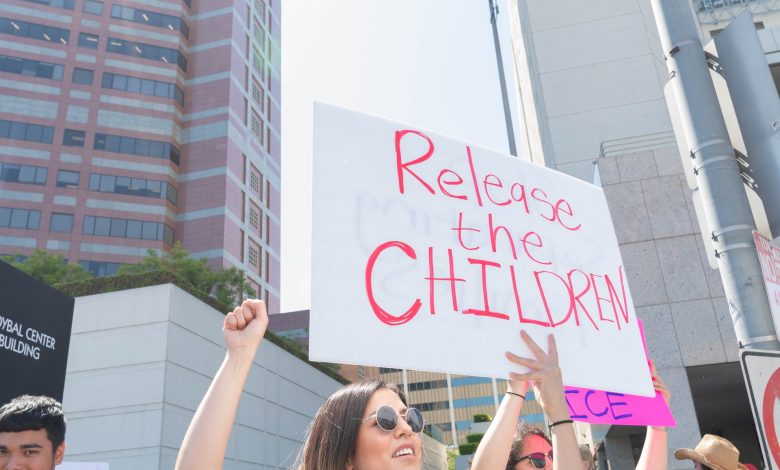
That growing frustration spilled into Washington this week, where dozens of protesters gathered near the White House carrying monarch butterfly posters and large banners reading “Set kids free” during a vigil organized by the Coalition to End Family and Child Detention.
The butterflies symbolized undocumented immigrants, while demonstrators demanded the closure of all immigrant detention facilities across the country. “Migration is beautiful,” said Anat Shenker-Osorio, one of the communications managers helping organize the event. “People move, and that should be celebrated.”
Anger grows over conditions inside Dilley
Many of the protesters who traveled to Washington came directly from Texas, where criticism surrounding the Dilley detention facility has grown steadily over recent months.
Advocacy groups and lawsuits have accused the center of unsafe living conditions, poor healthcare access, contaminated water, inadequate food, and failing to provide clean clothing for detainees, many of them children.
“Families are reporting worms and mold in the food that’s making children ill,” said Trudy Taylor Smith from the Children’s Defense Fund in Texas. “They are reporting a lack of access to clean drinking water. The tap smells foul. It’s making children sick, and yet if people want to avoid the tap and access clean water, they have to pay their own money to buy bottled water from the commissary.”
The Dilley facility is one of only two detention centers in the country that house immigrant families with children. Both centers had remained closed for years before reopening earlier this year under the Trump administration.
Since reopening, reports from inside the facility have triggered growing concern. In handwritten letters sent to ProPublica reporters, detained children described feelings of “sadness and depression.” Some wrote about constantly missing home and losing their appetites while being held at the center.
On the same day protesters gathered outside the White House, a group of congressional Democrats visited Dilley to inspect the conditions themselves. The delegation was led by Texas Democrat Joaquin Castro and included several other Democratic lawmakers from Texas, Arizona, California, and Maine.
After leaving the facility, Castro painted a grim picture of what lawmakers witnessed during the visit. “The kids, as you can imagine, were distraught. They were sobbing most of the time that we were with them,” Castro said. “When it comes to the Dilley detention center, it’s one horror after another and one abuse after another.”
Trump administration rejects criticism
The Trump administration has strongly denied accusations of abuse or neglect inside the detention center. In a public statement, officials said detainees are provided with healthcare screenings, educational resources, and infant care packages. “In most cases, this is the best healthcare illegal aliens have received in their entire lives,” the administration said in its release.
But those statements have done little to quiet critics, especially among activists and faith leaders working closely with immigrant communities in Texas.
Dianne Garcia, a pastor at Roca de Refugio Church in San Antonio, helped lead the White House protest with a moment of silence honoring detained and deported migrants. She said members of her own community have already been swept up in recent immigration raids, including single mothers sent to Dilley with their children. “I knew a 3-year-old. He used to be the most gregarious kid,” Garcia said. “Now he’s afraid all the time, always by his mother’s side.”
The emotional toll is also beginning to affect schools and communities far beyond detention facilities themselves. According to the Migration Policy Institute, roughly one in three children in Texas has at least one immigrant parent.
In Austin, school officials reported losing more than 3,000 students this year, partly because families feared immigration raids and detention operations. “When children don’t feel safe to go to school, when enrollment drops, that means teachers are laid off, that means they lose funding,” Taylor Smith explained.
Calls grow to abolish detention centers entirely
While the administration plans to expand temporary holding facilities for migrant families and unaccompanied minors, activists at the protest said they want the entire detention system dismantled. Several demonstrators condemned a proposed Louisiana detention center expected to temporarily house migrant families near Alexandria International Airport, where deportation flights already operate daily.
Concerns surrounding that site intensified after an investigation found contamination from PFAS chemicals, often called “forever chemicals,” which have been linked to cancer and other illnesses. Some former detainees attended the protest themselves, including Sulma Franco, who came to the United States from Guatemala in 2009 and was immediately placed in detention after arriving. “Being in a detention center is the same thing as being in a cage or being in jail,” Franco said. “I believe the solution isn’t improvement; the solution is to close them permanently.”
Organizers said their movement is not only about protesting current detention conditions but also changing how Americans discuss immigration enforcement entirely. Some demonstrators intentionally referred to detention facilities as “camps,” arguing the language better reflected the reality families experience inside them. For many at the protest, however, the issue came down to something much simpler. “This isn’t a difficult moral question,” Taylor Smith said. “Children don’t belong in cages.”