Republican unity faces a major test as GOP leader warns party could lose House if divisions deepen
 Wendy Harris
Follow on X
Send an email
April 16, 2026
Wendy Harris
Follow on X
Send an email
April 16, 2026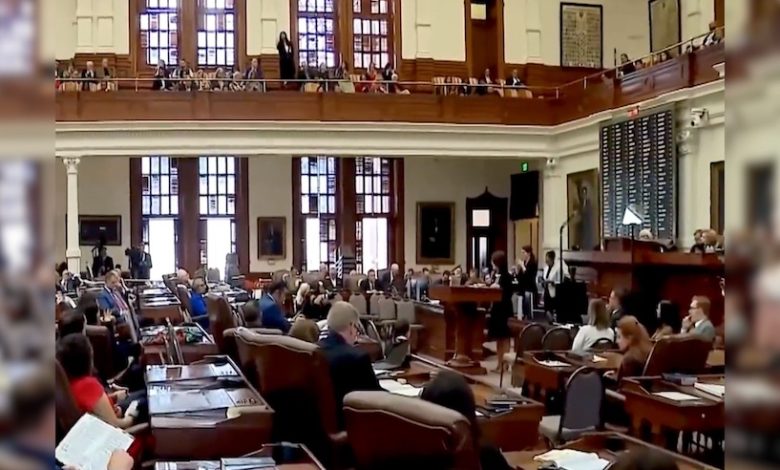
Texas – A rare warning from inside Texas’ Republican leadership is raising new doubts about what has long been considered a safe political stronghold. Lt. Gov. Dan Patrick is openly cautioning that internal party divisions—if left unresolved—could create an opening for Democrats to challenge control of the Texas House, even if the odds still favor Republicans.
Patrick’s message is not subtle. It is a direct call for unity at a moment when tensions inside the GOP are becoming harder to ignore. The growing divide, especially around the heated primary battle between U.S. Sen. John Cornyn and Attorney General Ken Paxton, is now being seen as more than just a short-term conflict—it could shape turnout, momentum, and ultimately control of power.
Internal Divisions Raise Real Risks
Speaking at the Texas Public Policy Foundation and later reinforcing his concerns at a policy summit, Patrick laid out a scenario that hinges less on Democrats gaining strength and more on Republicans losing cohesion. His concern centers on voter behavior—specifically, what happens if disappointed supporters simply stay home. “So he can’t get to over 50 unless Cornyn’s people or Paxton’s people decide to skip the race, because they’re mad that their guy lost. Get over it, get over it and come together as one,” Patrick said.
His warning is rooted in a simple but powerful idea: elections are not only won by persuasion, but by turnout. Even a small drop in participation could shift outcomes in tight races. Patrick emphasized that if just 10 to 15 percent of voters from either faction decide not to show up, the consequences could be immediate.
“John Cornyn, if you lose, you need to endorse Ken Paxton and get your voters to support Ken Paxton,” Patrick said. “And Ken Paxton, if you lose, you need to endorse John Cornyn and get your voters to support John Cornyn. Because if 10 to 15% of either of their sides don’t turn out and vote, James Talarico is going to win.”
Despite these concerns, Patrick stopped short of predicting defeat. Instead, he framed it as a warning about what could happen if unity breaks down. “I don’t think we’re going to lose. I’m just saying there is a pathway there,” Patrick said.
Confidence vs. Concern Inside the GOP
Not everyone within the Republican Party shares Patrick’s level of concern. Texas House Speaker Dustin Burrows pushed back strongly, projecting confidence in the party’s ability to hold its ground.
“We will not lose the Texas House. We will fight to retain every Republican seat. I look forward to the fall campaign where we get to talk about Texas’ prosperity under Republican leadership; and, I trust the voters of Texas to continue to vote for conservative government up and down the ballot!” Burrows wrote.
We will not lose the Texas House. We will fight to retain every Republican seat. I look forward to the fall campaign where we get to talk about Texas’ prosperity under Republican leadership; and, I trust the voters of Texas to continue to vote for conservative government up…
— Dustin Burrows (@Burrows4TX) April 8, 2026
That contrast—between warning and confidence—highlights a deeper divide within the party itself. While some leaders are sounding alarms, others are focused on reinforcing strength and stability.
Meanwhile, Democrats are watching closely and see opportunity in the cracks. State Rep. John Bucy argued that the political environment may be shifting in ways Republicans cannot ignore.
“The Lt. Governor has been beholden to Trump-style politics, and Trump-style politics are failing the American people, especially Texans. So I think they should be worried about losing the House,” Bucy said.
Changing Voters and Shifting Dynamics
Beyond internal conflict, broader changes are also reshaping the political landscape. Texas is not the same electorate it was years ago. Population growth, demographic shifts, and changing voter behavior are slowly altering the balance.
Political analysts point to the growing influence of Hispanic voters, who now make up roughly a quarter of the electorate. While Republicans made gains with this group in recent elections, that support is not guaranteed to hold. “If the Latino vote moves back to where it was in 2018 or 2020,” analyst Henry Olsen said, “Texas suddenly comes into play.”
That possibility does not require a complete political flip. Even small changes—just a few percentage points—could tighten races that once seemed safely Republican.
Patrick himself hinted at these broader pressures, pointing to recent election outcomes where Republicans underperformed expectations, even with strong endorsements. “I can come out here and be rah, rah, rah,” Patrick said. “Because if Democrats are in charge, guess what? You have nothing to do next year.”
He also warned of heavy Democratic investment in future races, saying, “And make no mistake, because of the race that we lost, the Democrats and George Soros will pour hundreds of millions of dollars. We’re going to have a tough time holding the Texas House.”
A Test of Unity and Strategy
For now, Republicans still hold a clear numerical advantage. They control 88 seats in the Texas House, compared to 62 held by Democrats. To flip control, Democrats would need to gain at least 13 seats—a difficult task given district maps that favor Republicans.
But recent history shows that internal party conflict can shift outcomes in unexpected ways. In Tarrant County, a Democrat was able to win a state Senate seat after attracting crossover support from voters frustrated by a divisive Republican primary.
As the May primary runoff approaches, followed by the November general election, the pressure is building. The path forward for Republicans depends not just on policy or messaging but on whether they can close ranks after a bruising internal fight.
Patrick’s warning captures the moment clearly. The threat is not immediate collapse, but slow erosion—missed votes, divided loyalties, and lost momentum. Texas may still lean Republican. But as this race unfolds, one thing is becoming harder to dismiss: unity is no longer optional—it may be the deciding factor.
Wendy Harris
Follow on X
Send an email
April 16, 2026