Ted Cruz explodes at Carlson in fiery rant as commentator calls Trump’s controversial image an “attack on Christianity”

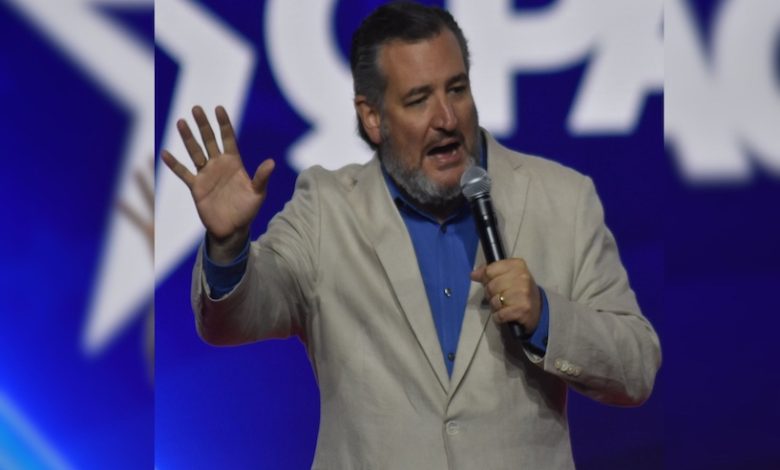
Texas – Texas Senator Ted Cruz has launched a fierce and highly personal attack on commentator Tucker Carlson, deepening a growing divide within conservative circles as controversy over Donald Trump’s AI-generated image continues to ripple across politics, religion, and international reactions.
The clash erupted after Carlson’s media network weighed in on an image shared by Trump that appeared to depict him as Jesus. What may have started as a social media post quickly turned into a layered political storm—drawing in global leaders, conservative influencers, and now a direct confrontation between two prominent right-wing voices.
Cruz’s Fiery Response Ignites New Feud
Cruz did not hold back. Reacting on social media, he accused Carlson of becoming a “deranged, Leftist psycho” who “loves Sharia” law, marking one of his most aggressive public criticisms of the commentator to date.
The trigger for Cruz’s reaction was a post connected to Carlson’s network that stated, “Muslims love Jesus.” The network used that message to argue that Trump’s controversial image crossed a line, writing, “That’s why Donald Trump’s painting depicting himself as the Son of God offended the president of Iran. It was an attack on his religion as well as Christianity.”
That framing appeared to push Cruz over the edge, as he has increasingly defended Trump amid mounting criticism from former allies like Carlson.
Trump’s Image Sparks Backlash at Home and Abroad
At the center of the controversy is Trump’s now-deleted post—an AI-generated image portraying him in a Christ-like form. The image surfaced shortly after tensions rose between Trump and Pope Leo XIV over the Iran conflict, adding another layer of sensitivity to the situation.
The backlash came quickly. Some of Trump’s own supporters, including Joe Rogan and Marjorie Taylor Greene, criticized the post. Despite the reaction, Trump insisted the image was misunderstood, claiming he thought it depicted him as a doctor rather than a religious figure. He also denied removing it because of criticism.
The reaction wasn’t limited to the United States. Iran’s president, Masoud Pezeshkian, issued a sharp condemnation, stating, “His Holiness Pope Leo XIV … I condemn the insult to Your Excellency on behalf of the great nation of Iran, and declare that the desecration of Jesus, the prophet of peace and brotherhood, is not acceptable to any free person.”
A Relationship That Has Been Breaking Down
This latest clash is not happening in isolation. The relationship between Cruz and Carlson has been steadily unraveling, especially since the Iran conflict began to dominate political debate.
Carlson has taken an increasingly critical stance toward Trump’s rhetoric and foreign policy approach. When Trump demanded Iran make an “unconditional surrender,” Carlson pushed back, prompting Cruz to fire back by saying the position was “to the left of [Sen.] Chris Murphy.” He went even further, stating, “That is more anti-American rhetoric than anything I’ve ever heard Bernie Sanders say.”
Cruz continued his criticism by adding, “Tucker continues to go to new lows and new lows. The more Tucker Carlson attacks Donald Trump the more fringe he gets.”
Carlson and Trump Trade Direct Blows
Carlson, for his part, has not softened his tone. After Trump posted an aggressive message toward Iran on Easter, Carlson accused him of crossing a moral and religious boundary.
“The message of all faith at the biggest picture level is the message in our Bible, which is you are not God. And only if you think you are, do you talk this way,” Carlson said. “But it’s not just mockery of Islam. And no president should mock Islam. That’s not your job. This is not a theocracy.”
He expanded on that criticism, warning against mocking religion altogether and suggesting that such rhetoric could inflame deeper conflicts.
Trump responded bluntly, dismissing Carlson entirely. “Tucker’s a low IQ person that has absolutely no idea what’s going on,” he said. “He calls me all the time; I don’t respond to his calls. I don’t deal with him. I like dealing with smart people, not fools.”
A Wider Rift Inside Conservative Politics
What makes this moment stand out is not just the intensity of the language, but what it signals. A once-aligned political space is now showing visible fractures. Figures who once shared similar platforms are now openly clashing over religion, foreign policy, and the limits of political messaging.
The controversy surrounding Trump’s image has acted as a spark—but the underlying tension runs deeper. Questions about tone, strategy, and ideology are now playing out in public, with Cruz, Carlson, and Trump each taking sharply different positions.
As reactions continue to build—from domestic critics to international leaders—the episode reflects more than a single dispute. It highlights a shifting dynamic within conservative politics, where loyalty, messaging, and identity are being tested in real time.
And if this exchange is any indication, those divisions are not fading quietly—they are growing louder, sharper, and far more personal.