Barack Obama casts doubt on Trump’s Iran breakthrough, arguing the deal may look a lot like the old agreement

Texas – Texas Republicans are emerging as some of the loudest critics of President Donald Trump’s new agreement with Iran, creating a rare public divide between the president and several longtime allies. At the center of the debate is Texas Sen. Ted Cruz, who has questioned the direction of the administration’s negotiations and warned that Trump may be receiving “some really bad advice on this deal.”
Cruz and fellow Texas Sen. John Cornyn have both raised concerns about provisions tied to the agreement, particularly proposals that could provide Iran with economic benefits and additional resources. Their criticism comes as another prominent voice has entered the discussion: former President Barack Obama, who is openly questioning whether Trump’s latest diplomatic breakthrough is truly different from the nuclear agreement he abandoned years ago.
According to Trump, the arrangement is effectively complete. “The deal’s all signed. And the strait is already partially opened,” he said while discussing the Strait of Hormuz, one of the world’s most important shipping routes. Trump added that he expected the waterway to be fully reopened within days.
The president also pointed to financial markets as evidence that the agreement was already producing positive results. He argued that lower oil prices and rising stock markets reflected growing confidence that conflict in the region was easing.
For Trump, the central achievement of the agreement is preventing Iran from obtaining a nuclear weapon. “The main thing is that Iran will not have a nuclear weapon,” he continued. “They fully agreed to that with strong policing powers, and they won’t have a nuclear weapon, which is what it was all about.”
Obama Questions Whether Anything Has Really Changed
While Trump has presented the agreement as a historic accomplishment, Obama has taken a far more cautious view.
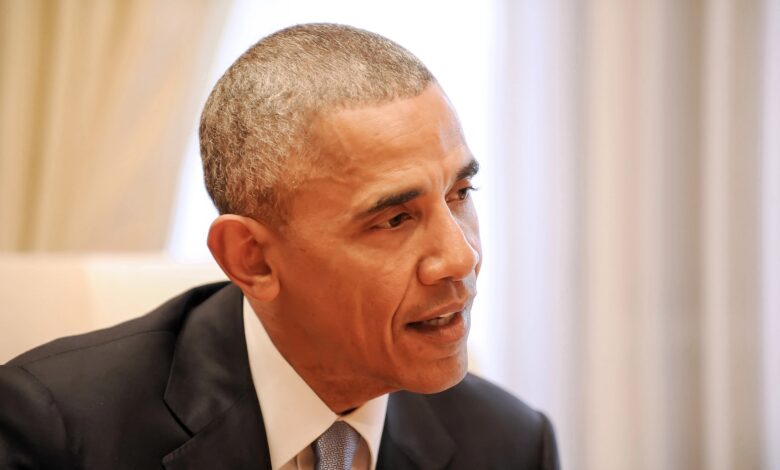
In an interview that aired shortly before Trump’s announcement, the former president suggested that expectations surrounding the agreement may be overstated. Obama noted that the United States had already negotiated a nuclear arrangement with Iran during his administration, one that remained in place until Trump withdrew from it during his first term.
Rather than seeing a dramatic shift, Obama indicated that the new agreement could end up looking remarkably familiar.
“It is doubtful that any agreement that arises is going to be significantly different or a significant improvement from the deal that we had in the first place and had worked for, for a long stretch of time before we, the United States, pulled out of it,” Obama told interviewer Robin Roberts.
His remarks immediately revived a long-running political argument over Trump’s decision to leave the original Iran nuclear agreement. Supporters of Obama have argued for years that the previous deal successfully limited Iran’s nuclear activities and provided monitoring mechanisms. Critics, including Trump and many Republicans, countered that the arrangement gave Tehran too much room to maneuver and failed to address broader security concerns.
Growing Republican Concerns
Obama is far from the only figure questioning parts of the new agreement.
Across Capitol Hill, skepticism has emerged from several Republicans, including some who have generally supported Trump’s foreign policy agenda.
Cruz has focused much of his criticism on reports that Iran could benefit from a massive reconstruction package connected to the agreement.
“History demonstrates that giving billions of dollars to theocratic lunatics who want to murder us is an exceptionally bad idea,” Cruz said. “If we give billions of dollars to Iran, that money will be used to murder Americans, and so I don’t believe we should do that.”
He also dismissed the idea of helping rebuild Iran after decades of hostility toward the United States.
“The idea that we would have, effectively, a Marshall Plan for Iran, and come in and rebuild Iran after they’ve been the leading state sponsor of terrorism for 47 years, they’ve murdered nearly 1,000 Americans, I don’t think that makes any sense,” Cruz added.
Cornyn voiced concerns of his own, arguing that Israel’s interests appeared to receive insufficient attention in parts of the framework.
“I would encourage them to continue to take the fight to Hezbollah, because, unfortunately, now Iran is going to have hundreds of millions of dollars to support its terrorist proxies, including Hezbollah,” Cornyn said. “So, I think that was a mistake.”
A Debate Far From Over
The contrast between Trump’s celebration and the criticism coming from both Democrats and some Republicans highlights how contentious the agreement has already become.
Trump sees a diplomatic victory that could lower tensions, reopen key trade routes, and prevent Iran from developing nuclear weapons. Obama, meanwhile, questions whether the agreement offers meaningful improvements over the deal that existed before Trump withdrew from it. At the same time, Republican critics from Texas and beyond worry that economic concessions could ultimately strengthen a regime they view as a long-term threat.
As more details emerge and lawmakers continue reviewing the agreement, the debate is likely to intensify. What Trump describes as a historic breakthrough is already becoming the latest battleground in a larger fight over American foreign policy, Iran’s future, and whether this deal represents genuine progress or a return to an approach many thought had been left behind years ago.