No endorsement, no peace: Texas Senate race erupts into political war as Trump refuses to pick a side in the Paxton-Cornyn battle

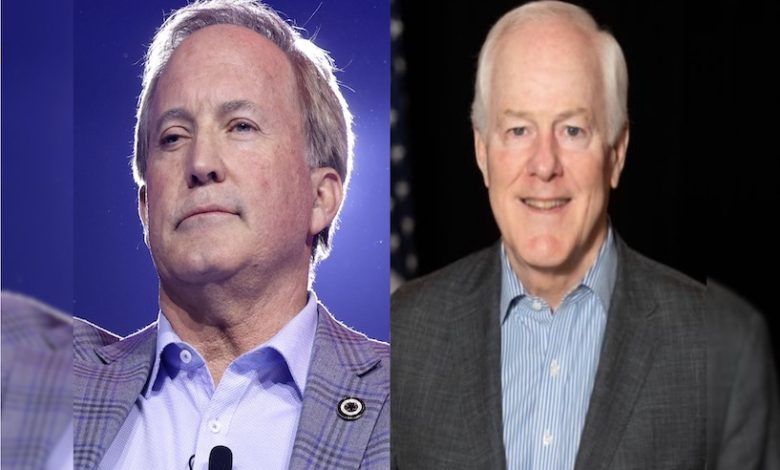
Texas – No endorsement, no peace. Texas Senate race erupts into political war as President Donald Trump continues to hold back from choosing between Sen. John Cornyn and Attorney General Ken Paxton, turning what was already a competitive runoff into a deeply fractured and high-stakes Republican showdown.
More than five weeks after signaling he would step in and endorse a candidate “soon,” Trump has instead remained on the sidelines, leaving both campaigns locked in a tense standoff that has only grown more intense as time passes. His early promise suggested a quick resolution, even hinting that the candidate he did not support should step aside for “the good of the Party,” followed by the rallying call, “We must win in November!!!” But that decisive tone has since faded, replaced by hesitation and unpredictability.
At one point, Trump sharply criticized Democratic nominee James Talarico, writing, “I believe that any human being running against him, sick, incompetent, close to death or even a child, would win,” adding, “He may be the Worst candidate I have ever seen.” That shift in focus has only deepened the uncertainty surrounding the Republican runoff, as Trump appears more concerned with the general election opponent than choosing between Cornyn and Paxton.
Rivalry hardens as Trump stays silent
Trump’s refusal to endorse before the candidate dropout deadline has had a clear impact on the race. What might have been a quick consolidation has instead turned into a prolonged and bitter fight. Political observers say the absence of a clear signal from Trump has allowed both sides to dig in.
“Trump not endorsing at this point has had an impact,” said Republican consultant John Wittman. “And so the reality is that this is still a very close race. Paxton is probably the favorite right now, but this is absolutely a winnable race for John Cornyn.”
The numbers reflect just how tight things are. In the initial primary, Cornyn secured 41.9% of the vote, narrowly ahead of Paxton’s 40.7%, with both candidates splitting suburban voters while dividing urban and rural support. Early runoff polling has shown Paxton with a slight edge, including one survey giving him an 8-point lead, while others found the race tied at 45%.
Behind the scenes, the campaigns are preparing for an all-out battle. The pro-Cornyn super PAC, Texans for a Conservative Majority, has already launched new ads targeting Paxton, including AI-driven attacks focusing on alleged ethical issues and personal controversies. Its leadership made clear that the quiet period will not last.
Voters, Aaron Whitehead said, will “see a lot more spending” as the race intensifies. He added, “The problem is, for Paxton, now that it’s mano a mano, we get to focus on him.”
Paxton, however, appears confident. Speaking at CPAC, he said he was “optimistic” about his chances and pointed to voter math he believes favors him. “We had six other people in the race — they took 18%,” Paxton said. “That 18%, we’ve done the analytics, more of them go to me than they do to John Cornyn. And finally, we’re gonna raise more money this time. He’s not going to outspend me 20 to 1.”
Money, messaging, and momentum collide
While Trump’s silence dominates headlines, the real battle is being shaped by money, messaging, and momentum. The primary race already shattered records, becoming the most expensive Senate primary for a single state in U.S. history, with more than $100 million spent.
Now, both sides are recalibrating for the runoff. Cornyn allies have spent over $2.2 million since early March, while Paxton’s team has spent far less so far, though they are expected to ramp up soon. Notably, some pro-Paxton advertising has been aimed directly at influencing Trump, with ads placed in markets he frequents.
The lack of endorsement has also left major donors uncertain. Without Trump signaling a preferred candidate, financial backing remains fluid, making fundraising a critical battleground in itself.
At the same time, outside factors are shaping the race. Paxton’s suggestion that he might consider stepping aside if the Senate passed the Save America Act brought new attention to election policy debates, while also aligning closely with Trump’s priorities.
Cornyn’s allies, meanwhile, continue to argue that he is the stronger general election candidate. “Democrats nominated their strongest candidate for U.S. Senate,” said adviser Matt Mackowiak. “Texas Republicans must nominate John Cornyn, who is our strongest nominee by far to gain five new congressional seats and advance Trump’s legislative agenda in the final two years of his second term. We have a plan to win the runoff and we are executing it.”
Support from national Republican leadership has reinforced that message. “We’ve been very clear that the fight to protect President Trump’s Senate Majority should not be fought in Texas, and John Cornyn is the only candidate who ensures that does not happen,” said Joanna Rodriguez.
High stakes with no clear end in sight
As the May 26 runoff approaches, the stakes continue to rise. Both candidates are now battling not only each other, but also time, money, and the uncertainty created by Trump’s silence.
The remaining voters, including the 13.5% who backed other candidates in the primary, could ultimately decide the outcome. Meanwhile, Democrats are watching closely, with Talarico emerging as a strong fundraiser and potential challenger in the general election.
Even some Republicans are expressing concern about what comes next. “I have concerns about the general election,” Sen. Ted Cruz said. “Regardless of who wins the nomination, the two candidates have attacked each other relentlessly, and the hard left is really energized.”
For now, one thing remains clear. Without Trump stepping in, the Texas Senate race has transformed into a fierce, unpredictable political war—one where both sides are digging deeper, spending more, and preparing for a fight that could shape not just the state, but the balance of power in Washington.