“Americans can’t make ends meet”: Schumer torches GOP for backing Trump’s billion-dollar ‘gold-plated ballroom’ and abandoning struggling families

Texas – Political tensions stretching from Washington to Texas have rapidly evolved into a much larger battle over security, government spending, and President Donald Trump’s expanding White House ambitions after the violent breach at the White House Correspondents’ Dinner reignited debates over political violence and presidential power. What initially began as outrage surrounding the armed attack at the Washington Hilton — where a Secret Service agent was injured while protecting Trump and other officials — has now collided with another growing controversy: the administration’s push for a massive ballroom and security expansion project critics increasingly describe as a taxpayer-funded vanity plan.
The fallout from the incident intensified after Texas Democratic Rep. Jasmine Crockett faced backlash for questioning whether the assassination attempt may have been staged, triggering days of political warfare online and on Capitol Hill. But while attention remained fixed on the political storm surrounding the attack, Trump and several allies simultaneously renewed pressure for the long-delayed White House ballroom project, arguing that expanded facilities and upgraded security infrastructure are necessary in a climate of escalating threats.
That argument has now exploded into one of Washington’s fiercest spending battles.
Senate Democrats are turning President Donald Trump’s White House ballroom project into a symbol of what they describe as misplaced Republican priorities, launching an aggressive campaign against a massive GOP-backed spending package that includes roughly $1 billion connected to the expansion effort.

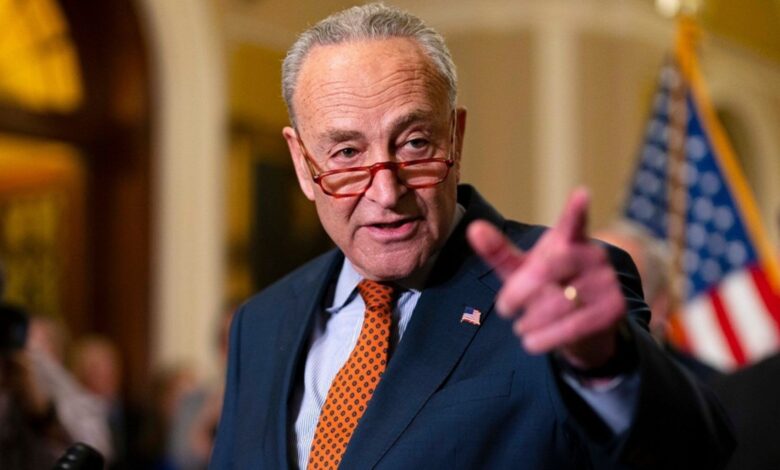
At the center of the fight is Senate Minority Leader Chuck Schumer, who has accused Republicans of pushing luxury-style projects for Trump while millions of Americans continue struggling with rising costs, healthcare expenses, and economic uncertainty. The battle has quickly become one of the most explosive political clashes unfolding in Washington as lawmakers return to Capitol Hill ahead of another high-stakes budget showdown.
The Republican reconciliation package totals roughly $72 billion and includes major funding increases for Immigration and Customs Enforcement, the Border Patrol, the Department of Justice, and the Drug Enforcement Administration. Buried inside the proposal, however, is funding Democrats say is tied to Trump’s controversial White House ballroom expansion project.
Schumer used a sharply worded “Dear Colleague” letter to rally Democrats against the legislation, framing the upcoming Senate debate as a larger argument over affordability and government priorities. “At a time when Americans can’t make ends meet, Republicans say ‘Let them eat cake’ — and then hand Trump a billion dollars to build a ballroom to serve it in,” Schumer wrote.
The New York Democrat repeatedly argued that ordinary Americans are being ignored while Congress focuses on what he described as a vanity project linked to the president. “Americans do not need a ballroom. They need relief,” Schumer declared. “They want their Congress and their President to address the growing cost crisis bearing down on families across the country.”
Democrats Prepare Full Senate Fight
Although Democrats do not have the votes to fully stop the reconciliation package, Schumer made clear they intend to make the process as politically painful as possible for Republicans.
He promised Democrats would use procedural tactics, amendments, Byrd Rule challenges, and repeated floor votes to force Republicans into defending the measure publicly. “Democrats will fight the Republicans’ reconciliation bill with every tool we have,” Schumer said.
He also vowed to repeatedly pressure Republicans on issues tied to healthcare cuts, tariffs, grocery prices, and housing costs. “And we will force vote after vote to make the choice unmistakable: will Republicans vote to help American families — to lower costs, to restore savage health care cuts, to roll back cost-spiking tariffs — or will they vote to fund Trump’s gaudy ballroom?”
The ballroom fight became even more politically charged after reports revealed that the White House initially planned to rely on private donations for the project before later asking Congress for federal funding after a judge ruled congressional approval would be necessary.
The project itself has already sparked controversy after the East Wing of the White House was unexpectedly demolished last year to make way for construction.
Trump has defended the expansion repeatedly, insisting reports about soaring costs are inaccurate. According to Trump, the original ballroom proposal started at around $200 million before being upgraded to a larger project costing under $400 million because of changes involving size and quality improvements. He has also denied that the project is over budget and claimed construction remains ahead of schedule.
Still, critics across the Democratic Party continue hammering the proposal.
California Gov. Gavin Newsom questioned whether Secret Service funding tied to White House security upgrades was effectively being used to support the ballroom construction. Rep. Ro Khanna accused Trump of hypocrisy over American manufacturing after reports suggested foreign steel could be used during construction. Sen. Elizabeth Warren also joined the criticism, accusing Trump of focusing more on personal branding while Americans struggle financially.
Bigger Political Tensions Emerging
The ballroom controversy is unfolding during a much broader fight over immigration funding, law enforcement spending, and the federal budget itself.
The GOP-backed package would fully fund ICE and Border Patrol operations through the remainder of Trump’s second term. Democrats have criticized not only the spending levels but also what Schumer called a lack of “single reform” or meaningful guardrails tied to federal enforcement agencies.
The debate comes shortly after a lengthy partial government shutdown that lasted 75 days following disputes over Department of Homeland Security funding and deadly incidents involving federal officers in Minnesota earlier this year.
Schumer also tied the current budget fight to growing frustration over inflation and the administration’s foreign policy decisions. “Families across the country are looking to Congress for relief — from rising costs, from chaos, and from an illegal war the President has no authorization to continue,” Schumer wrote.
He added that Republicans were advancing “a deficit-busting, party-line bill” while offering “No relief on groceries. No relief at the pump. No relief on health care, housing, or electricity bills.”
For Democrats, the strategy is clear: turn Trump’s ballroom into a political symbol of excess during a period of economic frustration. Republicans, meanwhile, appear determined to move the bill forward quickly through reconciliation rules that allow passage without Democratic support.
Trump wants the legislation signed by June 1, putting enormous pressure on Senate Republicans to finish the package before lawmakers leave Washington later this month.
As the battle intensifies, Schumer is already framing the issue as one voters will remember long after the Senate votes are over. “The American people are watching,” Schumer warned. “And in November, they will be voting.”